Views
What Is an Operating Partner in Private Equity? The Operator's Guide (2026)
What the role actually is when the slide deck hits the portfolio company: definition, deal-stage duties, the five flavours, pay, and where the role is heading.
Views
What the role actually is when the slide deck hits the portfolio company: definition, deal-stage duties, the five flavours, pay, and where the role is heading.
Value Creation
Funds are borrowing against their whole portfolio to manufacture cash. How it actually works, and who carries the risk.
Views
A continuation fund lets a PE firm sell an asset to itself instead of to a third party. How it compares to a traditional exit, when each is the honest choice, and the operator's tells for which one you are really in.

Views
A categorised, honest guide to the best private equity newsletters in 2026, grouped by role: daily deal flow, institutional trade reads, operator-focused newsletters, and commentary.
Views
The average tenure of a Chief Financial Officer at a private-equity-backed company in 2026 is 2.5 years. That is roughly half the 5.6-year average for public-company CFOs, and it means a typical portfolio company runs through two CFOs during a 5-year hold period.
Views
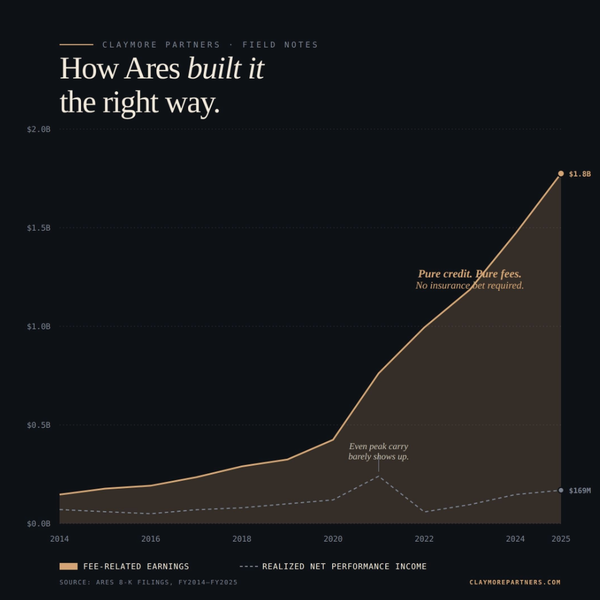
No insurance balance sheet. No synthetic spread income. No great mystical sermon about permanent capital while someone quietly bolts an annuity book onto the back of the firm. Just fees. From 2014 to 2025, Ares took fee-related earnings from roughly $150m to $1.8bn. Over the same period, realized
Views
Operating partners do not usually fail because they lack skill. They fail because nobody gave them authority, air cover, or a mandate anyone in the business actually respects. That is a very different problem. Private equity loves the idea of the operating partner. It sounds serious. Hands on. Value creation
Views
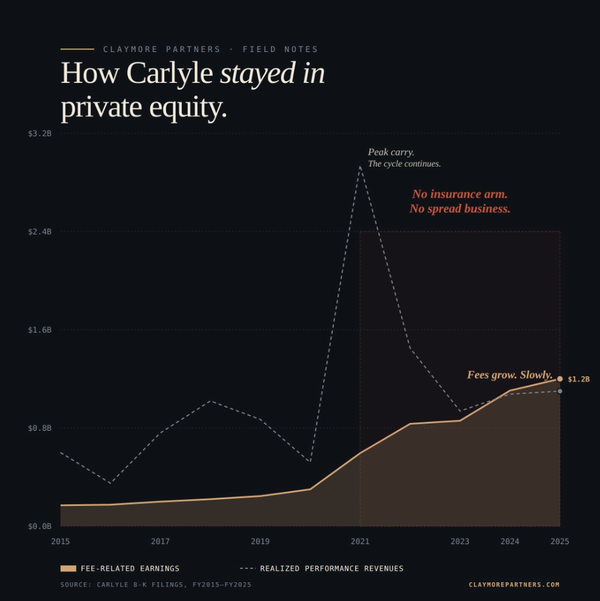
That sounds obvious, but it matters. The biggest alternative asset managers have spent the last decade making the model less dependent on the traditional private equity cycle. Insurance. Credit. Permanent capital. Spread earnings. Balance sheet scale. All very clever, all very useful, all slightly funny when the industry still calls
Views
Last week it launched its new Total Return Strategy: control private equity, lower leverage, up to 12-year holds, mid-teens gross return targets, and an initial annual dividend yield of roughly 5 to 8%. In other words, actual cash flow. Disgusting behaviour. Someone alert the IRR police. The interesting
Views
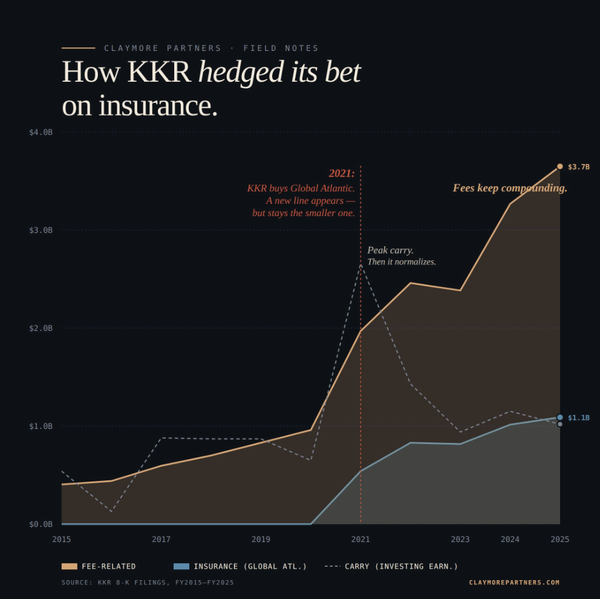
Which is usually where the money is hiding. In 2021, KKR bought Global Atlantic. At the time, it looked like another sensible adjacency. Asset manager buys insurance balance sheet, gets permanent capital, originates credit, collects spread. Everyone nods politely and pretends they were already saying it. Then the numbers started
Views
A carry winter is going to make private equity very weird. Not dead. Not broken. Just weird. For years, the industry has talked about DPI, exit backlogs, continuation vehicles, NAV loans and LP liquidity as if they are mainly investor issues. They are not. They are compensation issues. And compensation
Views
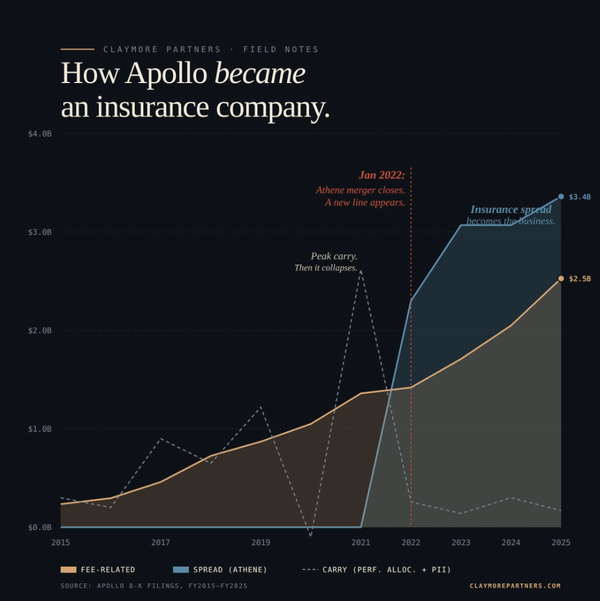
It is an insurance company with a private equity costume department. That sounds glib, but the chart is doing something useful. For years, Apollo looked like the classic alts model. Fees grinding along underneath. Carry bouncing around like a drunk analyst after bonus day. Great when markets are open. Less