
Carlyle is a useful reminder that most private equity firms are still private equity firms.

That sounds obvious, but it matters.
The biggest alternative asset managers have spent the last decade making the model less dependent on the traditional private equity cycle. Insurance. Credit. Permanent capital. Spread earnings. Balance sheet scale. All very clever, all very useful, all slightly funny when the industry still calls itself private equity with a straight face.
Carlyle sits closer to the older model.
Management fees grow.
Carry comes and goes.
Exits matter.
Market windows matter.
Fundraising matters.
That is not a criticism. It is the normal shape of the business.
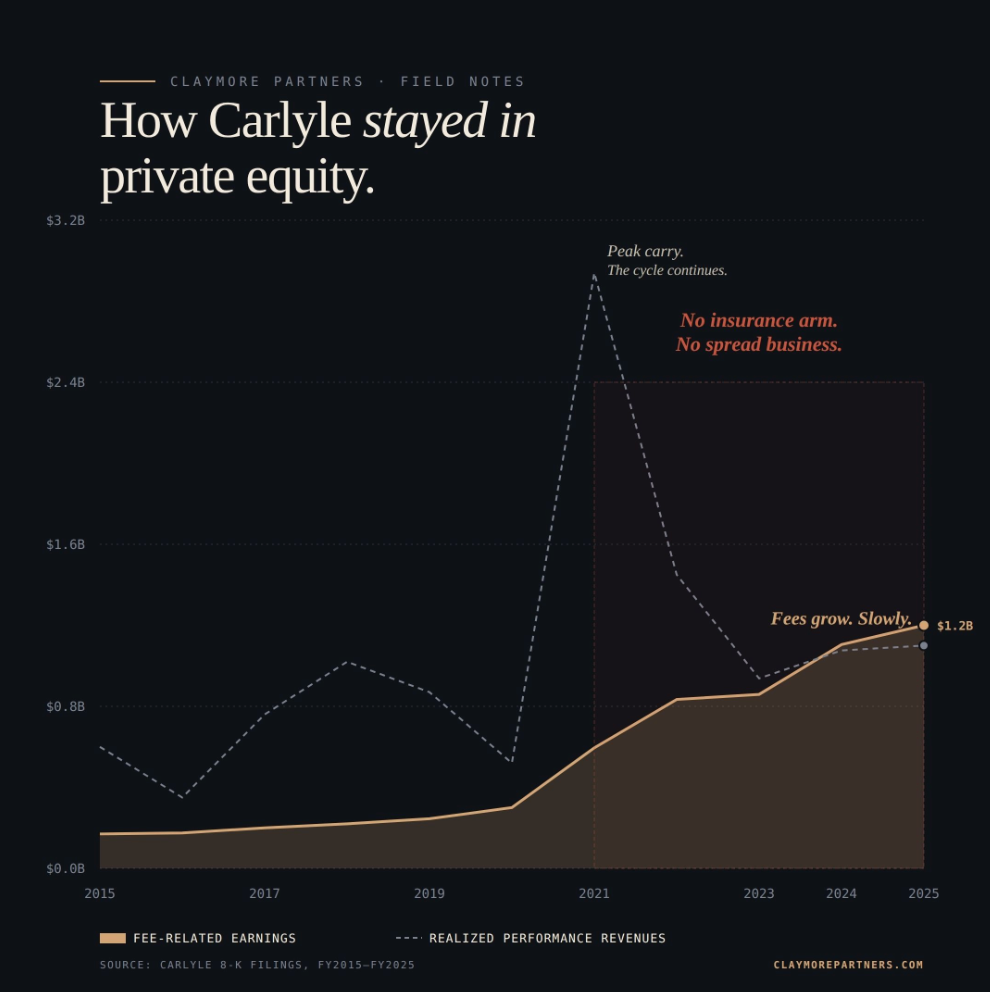
The chart is clean because the business is still relatively clean. Fee-related earnings have grown steadily, reaching roughly $1.2bn by 2025. That is the part public markets like. Recurring, visible, understandable.
The dashed line is the more traditional private equity bit. Realized performance revenues spike when the exit environment is good, then fall back when it is not. Which is exactly what carry does. It is not broken. It is just cyclical. Like pretending every company in the portfolio is “resilient” until the first refinancing memo lands.
The strategic question for Carlyle is not whether this model works. It clearly does.
The question is whether public markets will keep rewarding firms that look like classic private equity when the largest platforms are increasingly valued on earnings streams that look less like carry and more like financial infrastructure.
That is the real tension.
Carlyle stayed closer to the model most firms still live with.
The giants are the exception. Not the rule.