KKR’s insurance strategy looks boring on purpose.

Which is usually where the money is hiding.
In 2021, KKR bought Global Atlantic. At the time, it looked like another sensible adjacency. Asset manager buys insurance balance sheet, gets permanent capital, originates credit, collects spread. Everyone nods politely and pretends they were already saying it.
Then the numbers started to show the point.
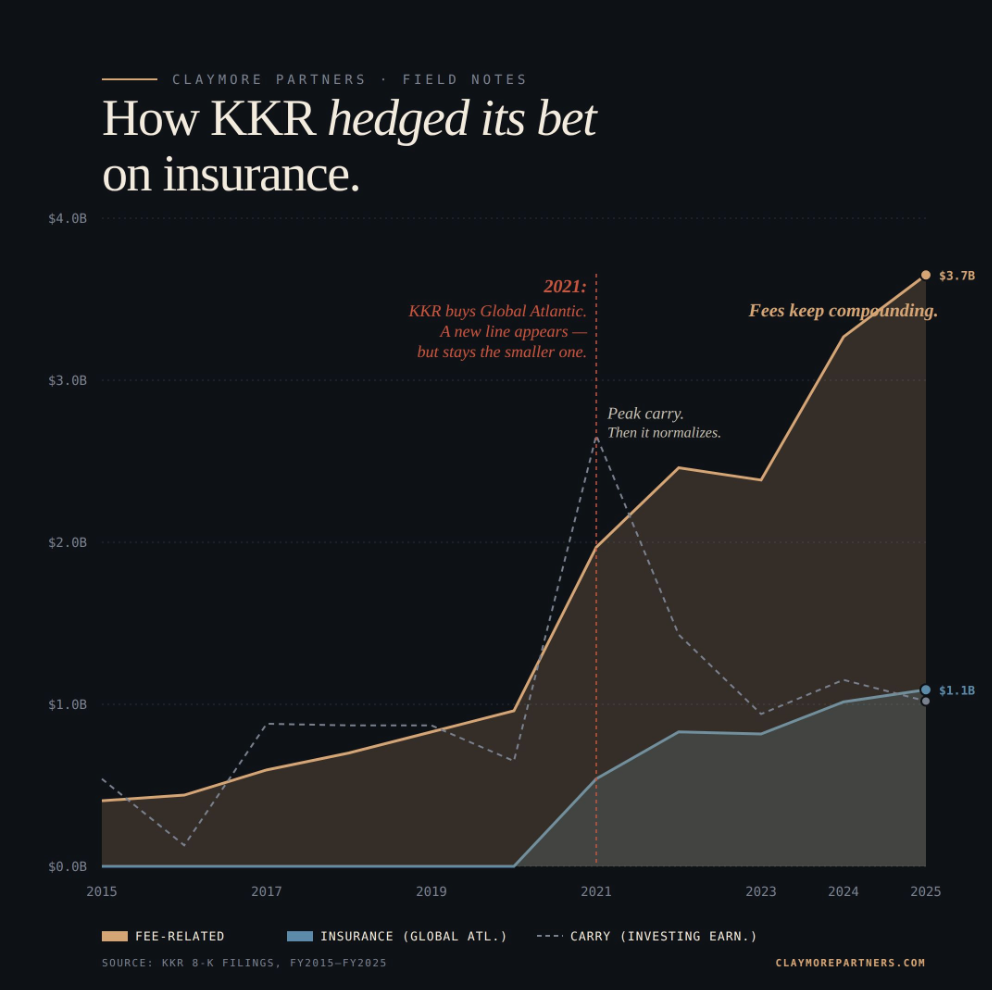
Fee related earnings kept grinding higher. Roughly $3.7bn by 2025.
Insurance operating earnings became a real line item too. Around $1.1bn.
Not the main act. Not a side quest either.
A hedge.
That is the interesting bit.
KKR did not need insurance to rescue the model. The fee engine was already working. What insurance gave them was a second earnings stream with different plumbing. Less dependent on exits. Less hostage to carry cycles. More tied to scale, origination, asset allocation and spread.
Private equity people love to talk about downside protection in portfolio companies. KKR actually built some into its own earnings model.
Very unsporting of them.
The dashed carry line on this chart is the reminder. Carry is beautiful when it arrives, but it behaves like a drunk uncle at Christmas. Loud, occasionally generous, and absolutely not something you build the family budget around.
The fee line is different. It compounds. Quietly. Boringly. Annoyingly well.
That is what the mega managers are really becoming.
Less “deal shop with carry upside.”
More earnings architecture.
Fees, credit, insurance, permanent capital, balance sheet yield, retail distribution.
The old model was win deals, improve companies, exit well, collect carry.
The new model is build a machine that earns even when exits sulk in the corner.
KKR has not abandoned private equity.
It has made itself less dependent on private equity behaving perfectly.
Which, given the current exit market, feels less like genius and more like basic adult supervision.