
Apollo hired three managing directors. Carlyle supplied one of them.
Apollo hired three managing directors, one of them from Carlyle. Advent's head of tech strategy now works at the OpenAI venture Advent helped fund.
Apollo hired three managing directors, one of them from Carlyle. Advent's head of tech strategy now works at the OpenAI venture Advent helped fund.

GTCR and Elliott are paying $7.75 a share for CCC. Advent sold its final stake last November at $7.79, down from a $10 SPAC-era price.

Proofpoint will pay $49.75 a share for Varonis, 52% above the June close. The multiple is 53 times free cash flow, and the first-half cash flow fell.

Fee-generating assets rose €40bn in the quarter. Strip out the Coller acquisition and the gain is about €6bn.
Watch Point Capital has a one-page website and two founders from Madison Dearborn and Platinum Equity. Here is what we can say about the new defence-focused firm.
GP financing is a loan or preferred instrument provided at the manager level, to the general partner, the management company or a sponsor affiliate, rather than to the fund. It is secured on what those entities and their owners actually hold, which means equity in the management company, the right
I would ask which level of the spectrum you are actually on. Because most portcos think they are a 4. They are a 2. And the gap between those two numbers is where the write-down lives. I have sat in enough board meetings where the CEO confidently describes their

I'd start by killing the theatre. Most operating models are built backwards. There's an ops team that is really a reporting team. There's a "value creation" function that is one person, a recycled PowerPoint, and a heroic ability to say "cross-
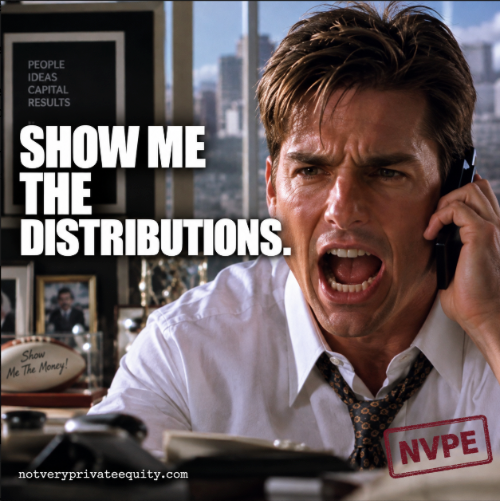
Saves everyone forty slides on why the portfolio is performing magnificently despite the absence of any money. The valuations are robust. The assets are exceptional. The exit pipeline is encouraging. Lovely. The pensioners have asked whether they can spend the appendix. Private equity gets paid to be patient. Fair enough.

A lot of LP meetings are no longer really about communication. They are about stage management. The deck is polished. The messaging is tight. The bad news has been moved three clicks deeper into the appendix. The winners get a cinematic retelling. The problems get translated into phrases like timing,
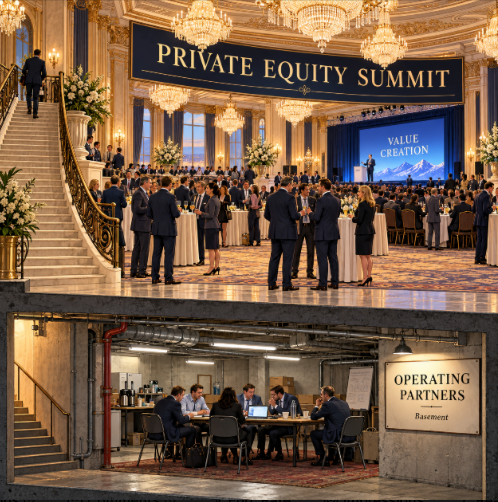
“Value creation” gets top billing on the main stage. Operating partners get a separate room, a different floor, sometimes an entirely separate event. The industry has managed to make the people responsible for delivering the investment thesis a fringe attraction. Quite an achievement. And giving operating partners their own conference

AE Industrial lost two partners to company jobs. Everyone else was hiring operators. Senior moves at the 200 largest US PE firms, week to 13 October.
Value Creation
Funds are borrowing against their whole portfolio to manufacture cash. How it actually works, and who carries the risk.

Toolkit
Most managers brace for the credit conversation and underprepare for the one that actually decides the outcome. Here is what tends to go wrong when GPs approach a NAV facility, seen from the side of the table that has to underwrite it, and what a sound deal should look like
Toolkit
Carried interest, usually called "carry", is the share of investment profits that a private equity firm keeps after its investors have been paid back. In a typical PE fund, the Limited Partners (the investors) put up the capital. The General Partner (the PE firm) runs the investments. When
Toolkit
A continuation fund is a new private equity fund that a PE firm raises specifically to buy one or more portfolio companies from an older fund it already manages. The old fund gets to exit. The companies move into the new fund. The PE firm keeps managing them for another
Toolkit
EBITDA add-backs are adjustments a company makes to its reported earnings to produce a higher "adjusted EBITDA" figure. The logic is that certain expenses in reported results are one-time, non-recurring, or non-operational, and so should be added back to arrive at the "real&
Toolkit
Buy-and-build, also called roll-up, is a private equity strategy where a firm buys a platform company in a fragmented industry and then acquires smaller competitors and adds them to the platform. Over 3-7 years, the combined group gets bigger and, in theory, more valuable per unit
Toolkit
An earn-out is a deal structure where part of the purchase price for a company is deferred and paid later, contingent on the acquired company hitting agreed performance targets. Instead of paying the seller 100% of the price at closing, the buyer pays, say, 80% upfront and 20% in
Toolkit
NAV lending, or NAV financing, is when a private equity fund borrows money using its portfolio of investments as collateral. Instead of the fund's individual portfolio companies taking on debt (the traditional way PE uses leverage), the fund itself takes on debt at the fund level, secured by
Toolkit
A covenant-lite loan, often shortened to "cov-lite", is a leveraged loan with fewer of the protective clauses that lenders traditionally used to monitor borrower performance and intervene early if things went wrong. Traditional leveraged loans included "maintenance covenants" that required borrowers to periodically meet
Toolkit
A tax receivable agreement, or TRA, is a contractual arrangement where a company agrees to share future tax savings with pre-IPO shareholders (often the private equity sponsor and the pre-IPO founders or managers). When a PE-backed company does an IPO using an "Up-C" structure,
Toolkit
"Two and twenty" is shorthand for the fee structure most private equity and hedge funds use to compensate the General Partner: a 2% annual management fee charged on committed capital, plus 20% of profits after a hurdle rate has been met. The 2% pays the firm's
Toolkit
A subscription line facility is a short-term loan to a private equity fund, secured by the fund's LP commitments. Instead of calling capital from LPs immediately when the fund wants to do a deal, the fund borrows from a bank, does the deal, and then either repays