The funniest thing about private equity is how little of it is actually private anymore.

Not because firms suddenly became transparent. Calm down. Let’s not get carried away.
Because underneath the industry now sits a shadow cap table of minority GP stakes, fee streams, carry participation, balance sheet bets and very polite strategic partnerships that mostly mean: “we would like a slice of your management company without having to run your Monday morning investment committee.”
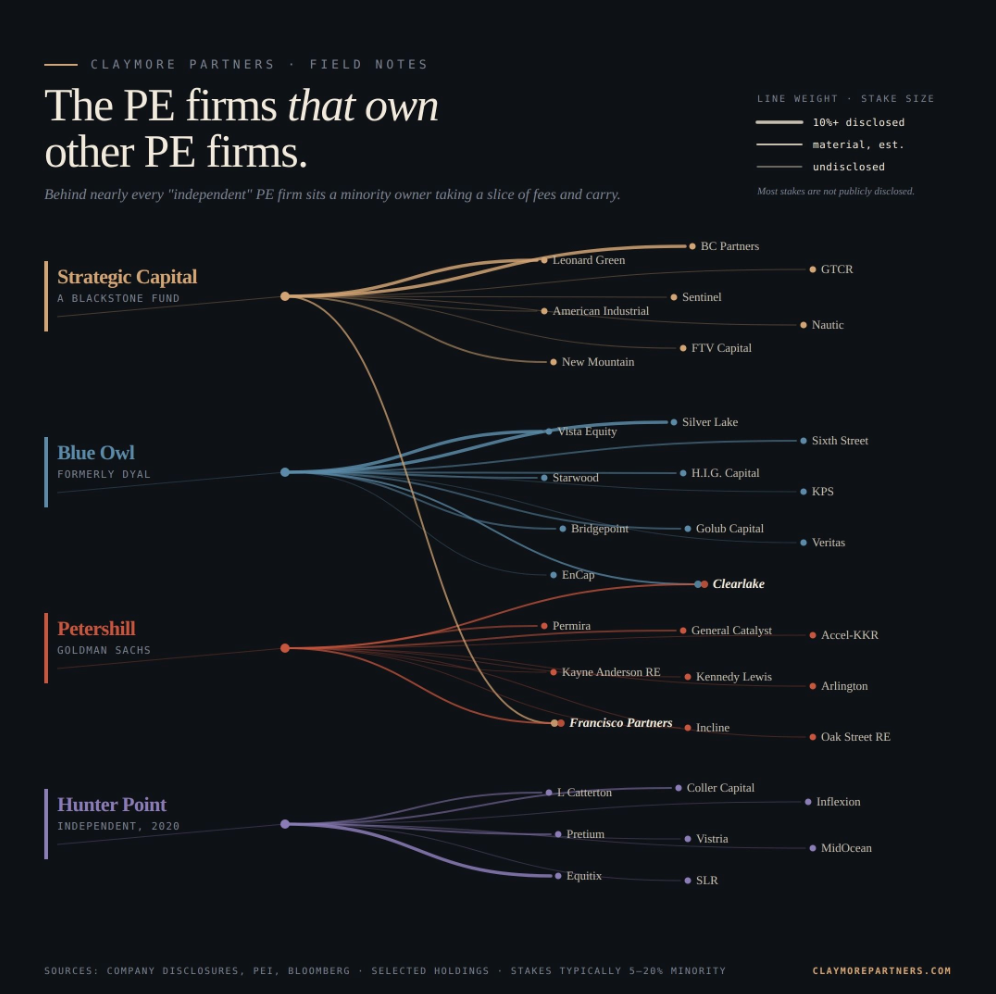
Blackstone Strategic Capital. Blue Owl. Petershill. Hunter Point.
Behind nearly every supposedly independent PE firm is another asset manager quietly clipping a piece of the economics.
Leonard Green. BC Partners. Vista. Silver Lake. Clearlake. Francisco Partners. GTCR. Sixth Street. Permira. L Catterton. General Catalyst.
Some of these are disclosed. Many are not. Most stakes are minority positions, typically in the 5 to 20% range, which is just enough to be economically interesting and not enough to make anyone use the word “control” in a meeting with lawyers present.
The point is not that GP stakes are bad.
The point is that private equity has become a fee stream ecosystem wrapped in an independence costume.
LPs commit to funds run by GPs. Other firms own slices of those GPs. Insurance capital, permanent capital, GP stakes funds and balance sheets all sit behind the curtain. Everyone is still calling it alignment, because apparently “beautifully layered fee extraction machine” tested poorly with pension trustees.
The firms that bought these stakes understood something simple. Owning companies is hard. Owning the people who charge fees for owning companies can be much cleaner.
Less heroic, obviously. But quite a bit more profitable.
And wonderfully private.