
PE does not have a talent shortage. It has a thinking shortage.

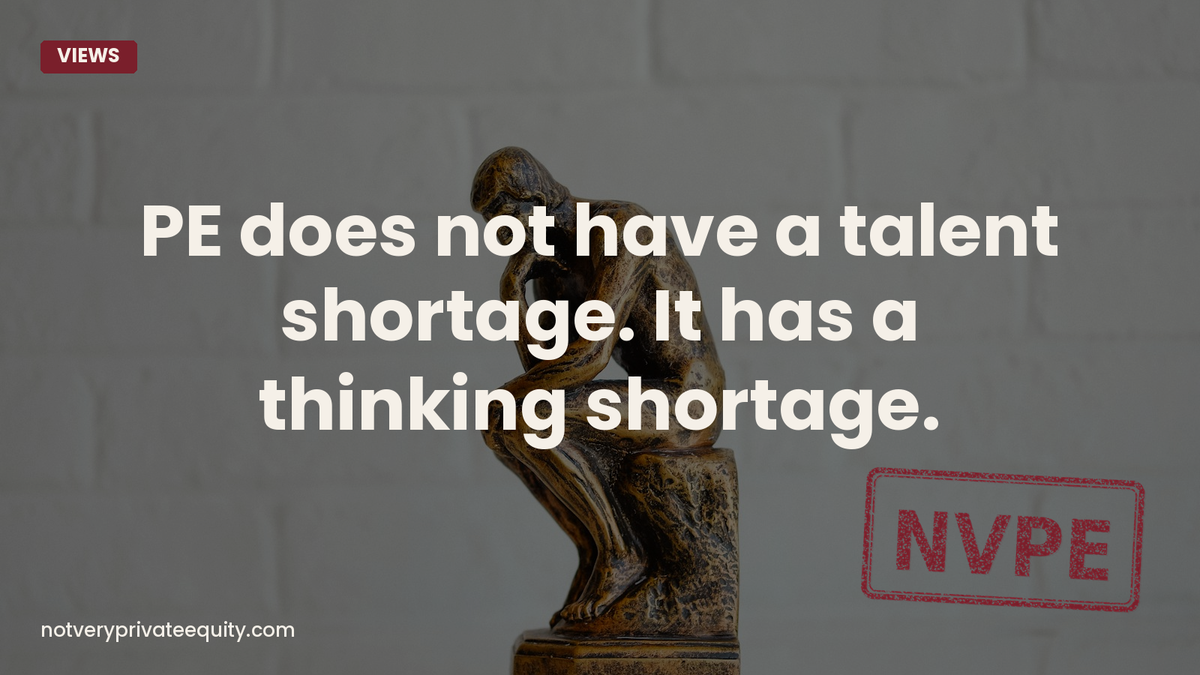
Most private equity firms have a diversity problem they do not talk about.
Not gender.
Not race.
Cognitive diversity.
The industry is full of people who look different enough for the website and think almost exactly the same.
Same schools.
Same training.
Same career tracks.
Same incentives.
Same pattern recognition.
Same way of speaking.
Same idea of what a good business looks like.
Same comfort zone in a meeting.
Same blind spots, repeated at scale.
That creates a very specific kind of firm.
Polished.
Analytical.
Commercially literate.
And often weirdly narrow in how it sees the world.
Because if everyone has been trained to think through the same lens, you do not get better judgment.
You get highly sophisticated consensus.
That is why so many firms crowd into the same sectors, chase the same deal archetypes, hire the same profiles, and call the same ideas differentiated with a straight face.
There is not enough intellectual friction.
Not enough people who think like operators.
Or founders.
Or actual customers.
Or branch managers.
Or someone who has had to make payroll instead of just model it.
So the room gets very good at sounding smart to itself.
And much worse at challenging its own assumptions.
That is the real cost of low cognitive diversity.
It is not just boring conversation.
It is bad underwriting.
Bad hiring.
Bad portfolio judgment.
And a chronic tendency to mistake familiarity for quality.
A lot of firms do not have an idea problem.
They have a sameness problem.
Everyone in the room can solve the model.
Very few can say, this company is culturally wrong, this CEO will never take the change, this market is less attractive than it looks, this business is better than the numbers suggest, or this whole thesis sounds clever and is probably nonsense.
Those are different skills.
And private equity still does not reward them nearly enough.
The industry likes to think better outcomes come from smarter people.
Often they come from having people in the room who do not think in exactly the same way.
That is the diversity problem worth talking about.
Because when everyone has a different biography but the same brain, you do not have a broader perspective.
You just have better optics on the same mistake.