Half the PE industry calls itself software-led now.

Sounds excellent in an LP meeting. The decks are immaculate. Everyone has read the Bain report. Someone has said “agentic” with a straight face.
Then you ask what the AI plan actually looks like at portfolio level.
Usually, it is a job title.
A Head of AI hire. An offsite with OpenAI. A few pilots. A steering committee. Then a press release written in that strange hostage-note language where nobody is allowed to say what the business actually does.
Meanwhile, nothing important has changed.
The product is still the same product.
The pricing still assumes old switching costs.
The roadmap still has the same 14 epics it had two years ago.
The customer is already testing three vendors, one internal tool and something built by a 24-year-old in procurement who is now accidentally more strategic than the board.
That is the problem.
PE bought software because it was sticky. But a lot of the stickiness was never product love. It was friction. Bad integrations. Workflow lock-in. Training pain. Data trapped in weird corners. Contract fatigue. The glorious moat of “we cannot be bothered to move.”
AI eats that first.
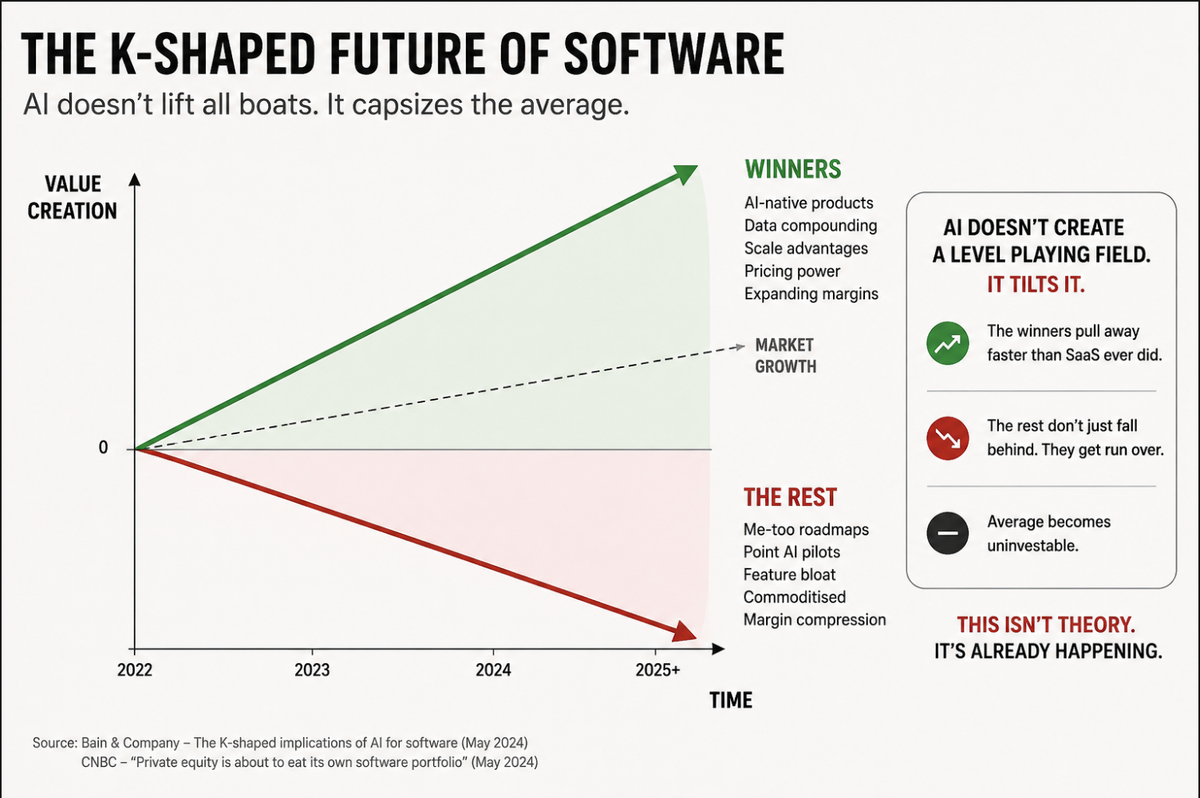
The Bain report calls it K-shaped. CNBC said PE may end up eating its own software portfolio. That sounds dramatic until you sit inside a portfolio review and realise half the “defensible software assets” are really just workflow toll booths wearing Patagonia vests.
The winners will pull away quickly. AI-native products, data advantage, pricing power, better margins.
The rest will discover that “mission-critical” is not the same as “irreplaceable.”
Anyone who bought vertical SaaS between 2020 and 2022 should be staring very hard at what they actually own.
Vertical SaaS was meant to be the safest room in PE.
It may just be the one without a fire exit.