
Blackstone’s best private equity deal may have been escaping private equity.

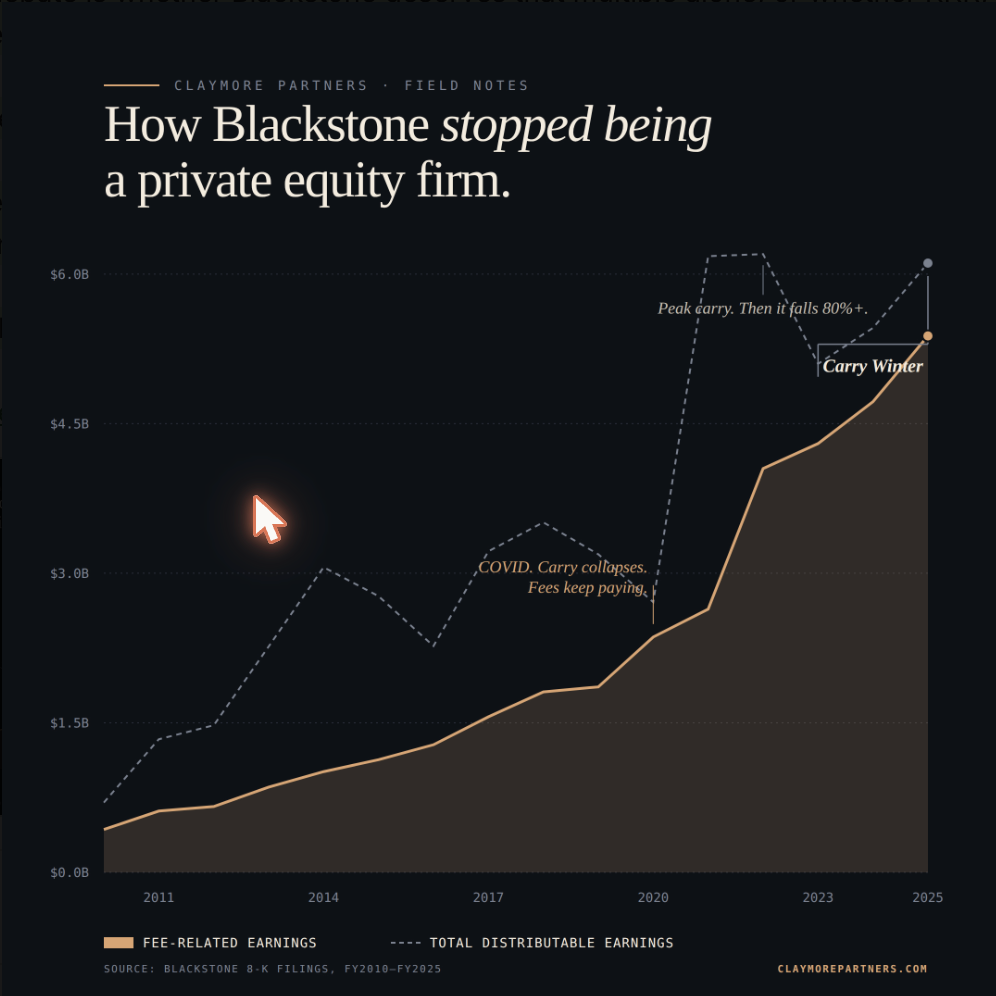
The chart is the whole story.
The gold area is fee related earnings. Recurring. Scalable. Predictable enough that public market investors can squint at it and pretend it is a software company with nicer shoes.
The grey dashed line is total distributable earnings, including realized carry. That is the bit everyone in private equity likes to talk about at dinners, on panels, and during the third glass of something expensive.
Look at the gap between the two.
2014 was lovely. Carry everywhere. Everyone clever.
2020 arrived and carry fell off a cliff. Fees kept paying.
2022 was the peak carry moment. Then came the carry winter. Exits slowed, realizations got awkward, and suddenly everyone remembered that paper marks do not fund dividends.
Fees kept paying.
That is the model shift. Blackstone stopped being valued like a traditional private equity firm and started being valued like a scaled alternative asset management platform with recurring revenue, permanent capital, private wealth distribution, credit, insurance, infrastructure, real estate, and a management fee machine underneath it all.
The market is not paying 30x FRE because it loves buyout nostalgia.
It is paying for durability.
Which is mildly inconvenient for the rest of the industry still pretending the old model works because the brand deck has a tasteful photo of a bridge on page 7.
The real debate is whether Blackstone deserves that multiple alone, or whether KKR, Apollo and the rest of the grown-up alts get pulled into the same frame.
The smaller debate is whether carry comes back.
The bigger debate is whether private equity firms that still rely on realizations to look clever have a very uncomfortable few years ahead.
Source: Blackstone filings and earnings releases, FY2010 to FY2025 estimate.