WPP is the world’s most expensive lesson in why agency roll-ups eventually turn into archaeology.

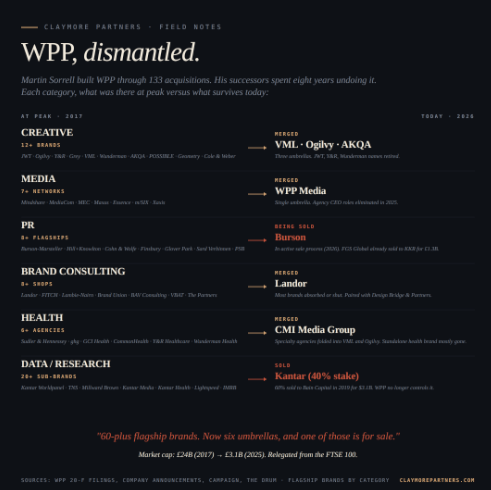
Martin Sorrell built the thing through 133 acquisitions. At its peak, WPP had more than 60 flagship brands spread across creative, media, PR, brand consulting, health, and data.
It looked impressive.
Which is usually the first sign something is hiding under the carpet.
Then came the clean-up.
VML, Ogilvy, AKQA merged.
Media folded into WPP Media.
Burson is being sold.
Landor absorbed most of the brand shops.
CMI Media Group swallowed the health agencies.
Kantar was mostly sold to Bain.
Market cap went from £24B in 2017 to about £3.1B in 2025. WPP was relegated from the FTSE 100.
Far from just a bad quarter. It's a business model having a small cardiac event in the lobby.
The old agency holding company model was built for a world where clients needed geography, headcount, and “integrated capabilities”, which mostly meant six agencies billing the same client while arguing over who owned the logo.
AI does not care about your agency architecture.
Procurement does not care about your legacy brands.
CMOs do not care that you bought a boutique in 2008 and still have the founder’s name on the door.
Boards care whether marketing produces revenue, margin, and measurable growth.
Very rude of them.
Publicis made a different bet. More data, more technology, more identity, more connected execution. Less agency cathedral. More operating system.
WPP is now trying to simplify what it spent decades complicating.
The lesson for PE is fairly obvious.
Roll-ups work until the customer stops paying for complexity.
Then the beautiful platform becomes a junk drawer with a logo.