
What Is Price Realization? A Plain Definition for PE-Backed Companies
Price realization is the share of intended price a company actually collects: realized price divided by list price. How to calculate it and where it leaks.

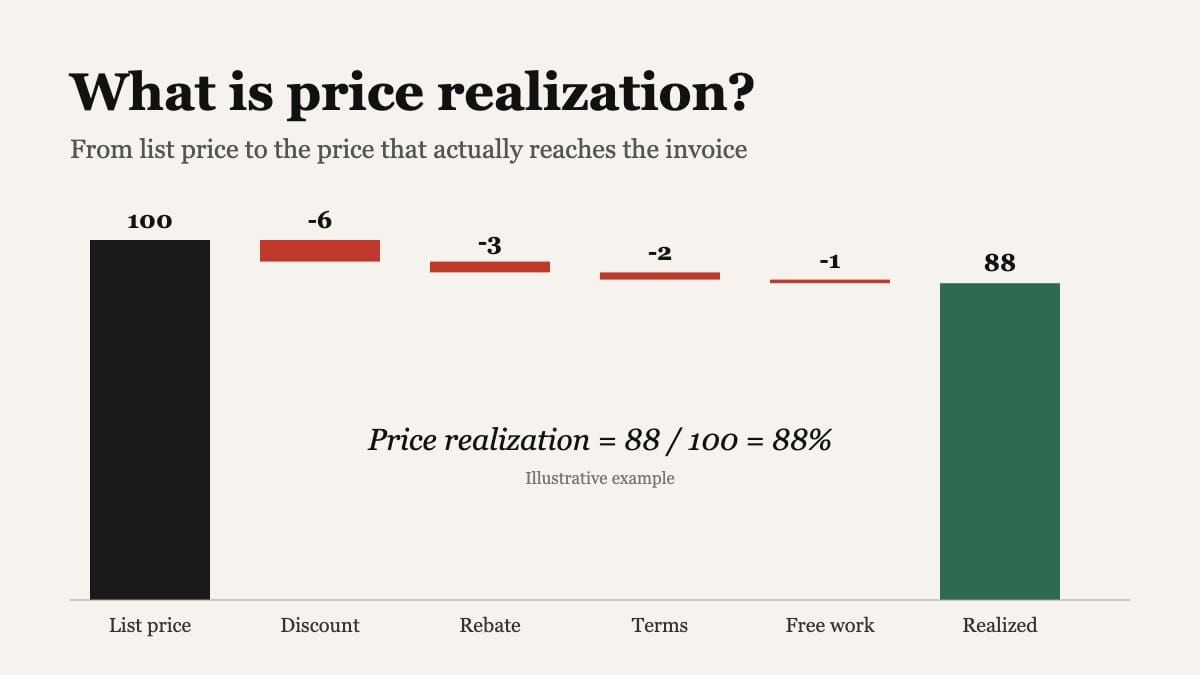
Price realization is the share of a company's intended price it actually collects. It is measured as realized price (after discounts, rebates, concessions and free work) divided by list or target price. In a PE-backed company it shows whether a pricing plan reached the invoice or stopped at the price list.
That is the definition. The reason it gets its own page is that most companies measure the price they announce and very few measure the price they collect. The gap between the two is where a pricing plan quietly goes to die, usually one "just this once" discount at a time. Every board deck says pricing power; realization is the number that tests the claim.
How to calculate price realization
The formula is simple: realized price ÷ list (or target) price.
Realized price is what the customer actually pays once everything has come off: on-invoice discounts, off-invoice rebates, extended payment terms, free implementation, the extra month nobody billed. Some teams call it pocket price.
A worked example in words. A product lists at 100. After a standard discount, a volume rebate, a payment-term concession and a little unbilled work, the average invoice settles at 88. Price realization is 88%. Twelve points of intended price never reached the P&L.
The same logic applies to increases. If the company announces a 6% price rise and average realized price goes up 2%, realization of the increase is a third. That second number, announced versus collected, is usually the one the board has never seen.
Where price realization leaks
- Discretionary discounting. Reps with discount authority and no consequence for using it.
- Off-invoice rebates. Volume or loyalty rebates paid quarterly, invisible on the invoice and often missing from the margin report.
- Unbilled scope and free work. Services, implementation hours or extras delivered and never charged.
- Payment-term concessions. Net 90 instead of net 30 is a price cut with better manners.
- Legacy contracts. Large accounts on old terms that nobody has repriced since the last owner.
- Mix shift. Volume drifting to lower-priced segments, products or channels, which lowers average realized price even when no single price fell.
Price realization vs pricing power vs price increase
- Pricing power is the ability to raise prices without losing volume.
- A price increase is the announcement.
- Price realization is what actually got collected.
The three are often used as if they were one thing. They are not. A business can have genuine pricing power, announce a sensible increase and still realize very little of it.
Why price realization matters in private equity
Collected price is the cleanest lever in a value creation plan. Cost to serve does not change when realization improves, so most of the gain falls through to EBITDA, which is why it shows up as its own line in an EBITDA bridge.
It also matters at exit. Buyers have learned to ask whether price changes reached invoices or only the price list. In a vendor-run survey of 215 respondents, the pricing consultancy Simon-Kucher found that 70% of firms evaluate pricing strategy but only 33% assess pricing implementation, and 37% cited evidence of price realization as a proof point buyers want. Strategy gets reviewed. Implementation, which is where realization lives, mostly does not.
How to track price realization
- Monthly, from invoice data. By segment, product, region and rep. Quotes and list prices are not evidence.
- A price waterfall. A bridge from list price to pocket price that shows each discount, rebate and concession as a step, so the biggest leak is obvious.
- Announced vs realized. For every increase, track the planned uplift against the collected uplift for at least two quarters.
- Joint ownership. The CFO owns the number; the revenue leader owns the behavior that moves it. If only one of them is in the room, it does not move. A working revenue operations function is usually what makes the data trustworthy.
Related terms
- What is an EBITDA bridge?
- What is a quality of earnings report?
- What is a value creation plan?
- What is revenue operations (RevOps)?
FAQ
What is price realization?
Price realization is the share of a company's intended price it actually collects. It is measured as realized price (after discounts, rebates, concessions and free work) divided by list or target price. In a PE-backed company it shows whether a pricing plan reached the invoice or stopped at the price list.
How do you calculate price realization?
Divide realized (pocket) price by list or target price. Use invoice and credit-note data, not quotes, and track it monthly by segment, product and rep so you can see where the gap opens.
What is a good price realization rate?
It depends on the industry and the discount policy, so there is no universal benchmark. The useful numbers are the trend over time and the gap between the price increase announced and the increase actually collected.
What is the difference between price realization and pricing power?
Pricing power is the ability to raise prices without losing volume. Price realization is how much of the intended price is actually collected. A company can have pricing power and still leak most of it through discounts.
Why do PE firms care about price realization?
Collected price drops almost straight to EBITDA, because the costs of serving the customer do not change. Buyers at exit also want evidence that price moves reached invoices, not just the price list.
What is a price waterfall?
A step-by-step bridge from list price to pocket price. Each step shows a discount, rebate, payment-term concession or free service that removes value, so the biggest leaks are visible in one chart.
Part of the NVPE private equity glossary.