What a Transaction Efficiency Benchmark Reveals About Deal Automation

Ask a transaction team what "efficient" looks like, and the answer usually comes back the same way: fewer steps, less manual work, more automation. That's the wrong place to stop.
Removing administrative work matters mainly because of what it frees a professional to do instead. It allows them to assess a proposal's commercial implications, negotiate its terms, make the call, and keep deal relationships intact. The true value lies in expanding the time available for human judgment, rather than simply reducing work for the sake of it.
This article explores which parts of a transaction can be streamlined without cost, and which start to lose something the moment they're pushed past a certain point. Term sheets are the clearest example. Technology can structure a negotiation, but it doesn't run it.
Reporting and communications look similar on the surface and turn out to need very different treatment. Some tasks on the critical path are strong candidates for automation. Others aren't, or not fully, and treating 100% efficiency as the finish line assumes otherwise.
Not All Workflows Should Aim for 100% Efficiency
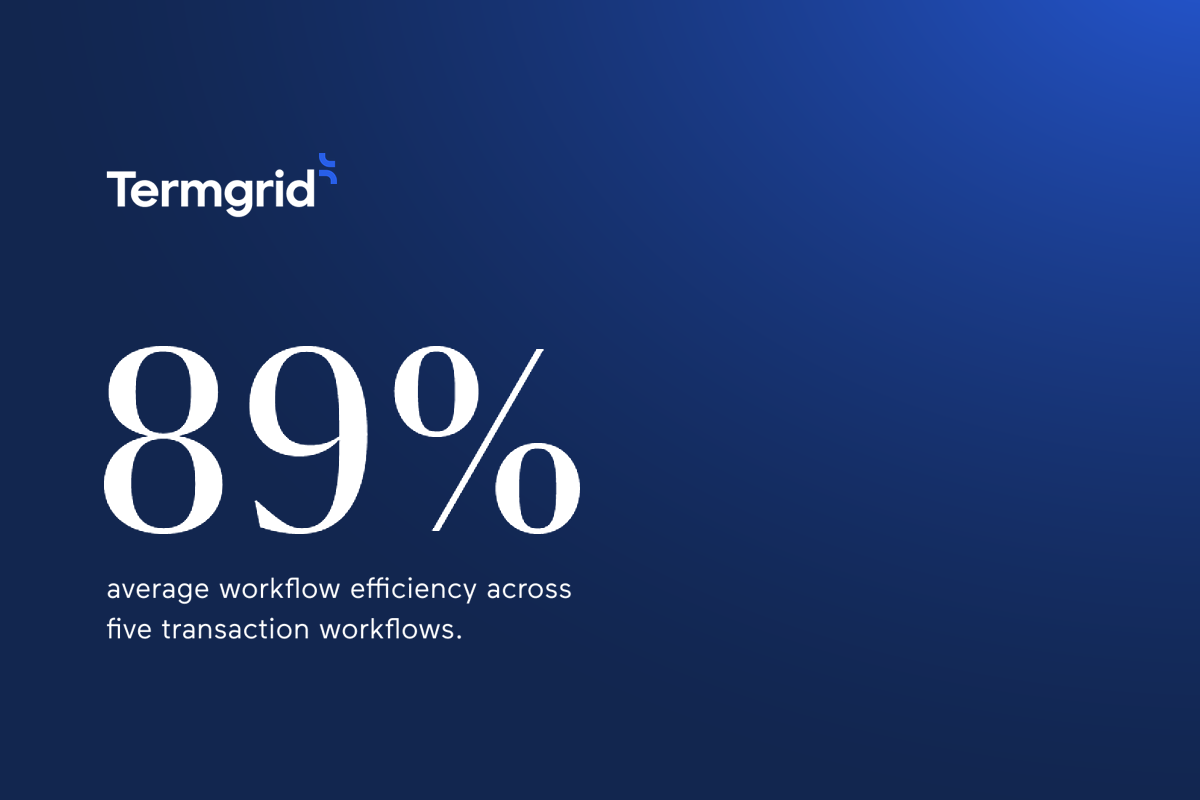
A recent report from Termgrid put a number on this by benchmarking five core transaction workflows across the first half of 2026: How much of the administrative effort in each one could be removed through structured, connected processes, without asking any human step to disappear along with it.
The results:
● Reporting: 100%
● Datarooms: 95%
● NDAs: 95%
● Term sheets: 92%
● Communications: 77%
Datarooms, NDAs and reporting are procedural by nature. Uploading documents, tracking permissions, and preparing status updates are primarily procedural tasks, making the automation of the manual effort around them a clear gain in efficiency.
Communications, at 77%, sits at the other end because while automation helps streamline the workflow, the core conversations between counterparties naturally require ongoing discussion to reach decisions.
Term sheets, at 92%, land in between for a similar reason: while comparing proposals can be effectively streamlined, the final decisions around them still rely on the team's judgment.
Term sheets: Technology structures the comparison, human judgment drives the decision
Term sheets are a useful place to see this play out, because the workflow combines both dynamics in a single process.
A typical financing round runs several lenders' proposals through multiple rounds of negotiation. Each new version has to be measured against the last: what changed, what that might mean for the sponsor's position, and whether the working comparison still holds up. Historically, that comparison gets rebuilt by hand every time a new term sheet lands. That work is usually:
● Necessary, since the team is negotiating from that comparison and needs to trust it
● Largely mechanical, closer to tracking changes than evaluating them
● A step that has to happen before the negotiation can move forward, more than a part of the negotiation itself
This is where Termgrid's role in the workflow sits. It holds competing term sheets in a live, structured comparison and keeps that comparison current as terms shift, so the team spends less time rebuilding it from scratch with every new version. Where it steps back is in forming a view on which terms a sponsor should accept. That judgment, shaped by the relationship, the market, and the deal's specific pressures, stays with the deal team.
That remaining 8% of the workflow essentially reflects the negotiation process itself. Pushing for further efficiency there would mean attempting to automate human judgment rather than supporting it.
Reporting and communications look alike. The difference is what each one is for.
Reporting and communications sit next to each other on the list because both involve moving information between people. Past that surface similarity, they tend to solve different problems, and treating them as interchangeable is one way a team ends up automating the part of its process that needed a person.
Reporting largely exists to present information that already exists somewhere in the transaction. The traditional version of that job often meant exporting data, pulling it together from wherever it was captured, and rebuilding it into an update, essentially recreating work already done.
When reporting is generated more directly from a structured, connected workflow, much of that recreation step falls away, which is why it's the one workflow in the report that reaches 100%. The aim isn't just to help people assemble updates faster, but to free up more of that time for interpreting what the numbers mean.
Communications works differently, because much of the value in that workflow is the conversation itself: sponsors, lenders, advisors and counsel talking to each other as a deal moves forward. Few would call that conversation the inefficient part. What tends to add friction is what builds up around it:
● Re-establishing context that already exists somewhere else in the deal
● Tracking down the current version of a document before the conversation can start
● Confirming a status that should already have been visible
● Repeating an update because a new stakeholder just joined the thread
Comparatively little of that is the relationship itself. Much of it is friction sitting on top of the relationship, and that distinction is close to what the 77% is measuring: less a shortfall to close, more a reflection of how much of the workflow sits outside the deal to begin with. Reduce that share, and the likely result isn't fewer conversations. It's closer to the same conversations, with less setup cost attached to each one.
What the freed-up time is for
Put the five results side by side and a pattern emerges. Even if it isn't a strict rule, workflows that are mostly procedural tend to reach near-total efficiency. However, workflows that lean more on judgment, tend not to, because pushing further would mean automating the part of the job a person is best placed to do.
Seen that way, the 89% average looks less like a score to close and more like a rough map. It points to where administrative effort can often be reduced without much cost to the process, and where reducing it further might cost the process something it relies on. That second category is smaller, but it tends to matter more:
● Assessing the commercial implications of a proposal
● Negotiating its terms
● Making the final call
● Managing the relationships that keep a deal moving
Automation doesn't typically make those steps faster on its own. Once the administrative work around them clears away, automation creates more room for a professional to focus. This allows them to dedicate more time to the parts of the job that most depend on their judgment.
That's a fairly grounded argument for transaction technology, and it's a narrower one than "automate everything," by design. The goal isn't to take the professional out of the process. It's closer to making sure that, once they're in it, more of their time goes toward the judgment they were brought in to apply.
The full Transaction Efficiency Report goes into the methodology behind all five findings, including where its own conservative assumptions likely understate the picture.