Public markets are getting a bit sniffy.

Private equity, naturally, has taken that as an invitation.
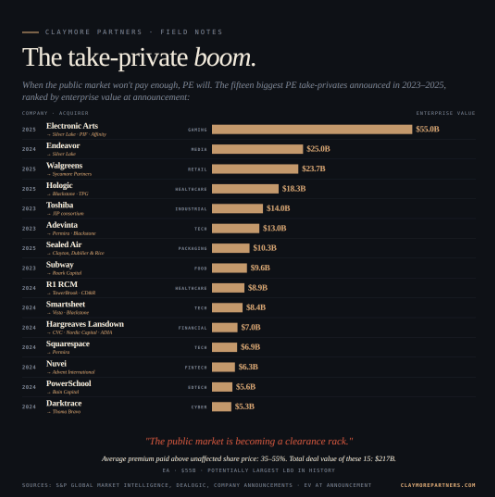
The 15 biggest take-privates announced since 2023 add up to $217B of enterprise value. EA at $55B. Endeavor at $25B. Walgreens at $23.7B. Hologic, Toshiba, Adevinta, Sealed Air, Subway and the rest of the “apparently misunderstood by public investors” club.
Average premiums have been running around 35 to 55 percent above unaffected share price.
Which tells you two things.
First, the public market is increasingly a clearance rack for assets that are too messy, too slow, too unfashionable, or too awkward to explain every 90 days to people with spreadsheets and the patience of a toddler.
Second, PE does not buy these companies because they are cheap. It buys them because there is control value the public market either cannot see, cannot wait for, or cannot stomach.
That distinction matters.
Some of these deals will be brilliant. Some will be expensive therapy sessions with leverage. A few will discover that taking a company private does not magically fix bad strategy, weak execution, bloated costs, confused customers, tired brands, bad tech, and management teams who think “transformation” means a new logo and a better slide template.
But the direction of travel is obvious.
When rates are higher, exits are slower, IPO windows are unreliable, and public investors punish anything that smells complicated, PE will go hunting.
Not for perfection.
For fixable imperfection.
That is where the money is.
The danger is pretending every discounted public company is secretly a misunderstood gem. Some are just structurally knackered businesses wearing a valuation multiple with a head injury.
Control only creates value if you actually do something with it.
Otherwise, it is just an expensive way to avoid quarterly earnings calls.